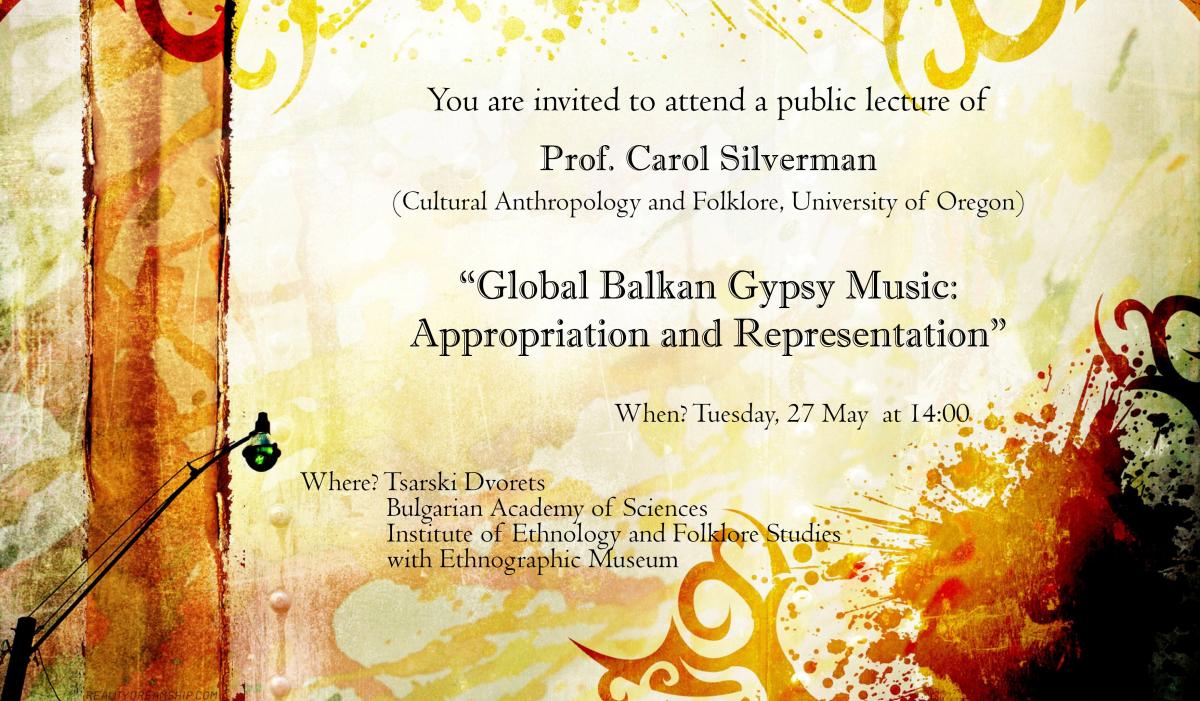

MAY, 27: LECTURE OF PROF. CAROL SILVERMAN AT THE INSTITUTE OF ETHNOLOGY AND FOLKLORE STUDIES WITH ETHNOGRAPHIC MUSEUM, BAS
Prof. Carol Silverman will give a lecture "Global Balkan Gypsy Music: Appropriation and Representation", at Tsarski Dvorets, Institute of Ethnology and Folklore Studies with Ethnographic Museum, Bulgarian Academy of Sciences, May 27 (Tuesday), 2 p.m.
Carol Silverman is a Prof. of Cultural Anthropology and Folklore at the University of Oregon. In the last twenty years the popularity of Balkan "Gypsy" music has exploded, becoming a staple at world music festivals and dance clubs in the United States and Western Europe. At the same time, thousands of Balkan Roma have emigrated westward due to deteriorating living conditions, and entrenched stereotypes of thievery have arisen amidst deportations and harassment. In this heightened atmosphere of xenophobia, Roma, as Europe’s largest minority and its quintessential “other,” face the paradox that they are revered for their music yet reviled as people. Balkan Gypsy music is simultaneously a commodity, a trope of multiculturalism, and a potent in-group symbol in cosmopolitan contexts. Focusing on clubs and festivals, this ethnographic presentation investigates the ramifications of the current scene for Romani performers and non-Romani musicians, producers, audiences and marketers.
Carol Silverman has been involved with Balkan culture for over 25 years as a researcher, teacher, activist, and performer. Focusing on Bulgaria and Macedonia and Balkan Roma in the American and West European diasporas, her research explores the intersection of politics, music, human rights, gender, state policy and representation. Her current project, supported by the Guggenheim Foundation, examines the globalization of "Gypsy" music. She also serves on the Boards of Directors of Voice of Roma and the Gypsy Lore Society. Among her recent publications are Romani Routes: Cultural Politics and Balkan Music in Diaspora (Oxford University Press, 2012, Merriam Book Prize, Society for Ethnomusicology); Global Balkan Gypsy Music: Issues of Migration, Appropriation, and Representation, in The Globalization of Musics in Transit: Musical Migration and Tourism, eds. S. Krüger and R. Trandafoiu, Routledge University Press (2013); Education, Agency, and Power among Macedonian Muslim Romani Women in New York City, Signs: Journal of Women in Culture and Society (2012); Gypsy Music, Hybridity and Appropriation: Balkan Dilemmas of Postmodernity, Ethnologia Balkanica (2011); Music, Emotion, and the “Other”: Balkan Roma and the Negotiation of Exoticism, in Interpreting Emotions in Russia and Eastern Europe, eds. M. Steinberg and V. Sobol, Northern Illinois University Press (2011).