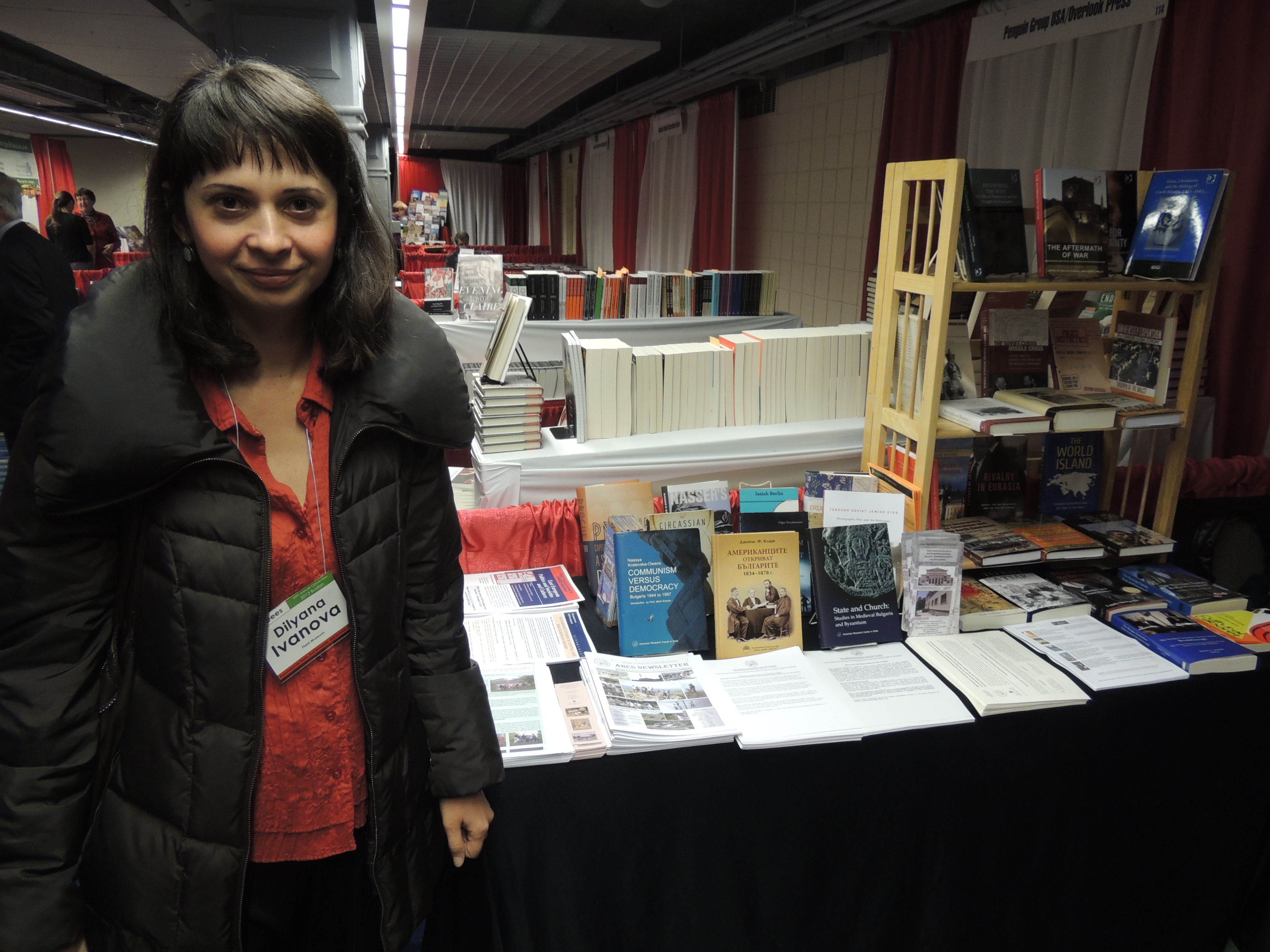

ARCS at the ASEEES Convention in Boston
The American Research Center in Sofia (ARCS) at the 45th Annual Convention of the Association for Slavic, East European, and Eurasian Studies (ASEEES) in Boston, November 21-24, 2013
Dr. Dilyana Ivanova, Administrator of the US Office of the American Research Center in Sofia, represented ARCS at the 45th annual convention of the ASEEES in Boston, MA (November 21-24, 2013). Promotional materials for ARCS were displayed in the convention’s exhibit hall, including brochures, fellowship announcements, and publications of the Center. The exhibit corner for ARCS attracted the attention of many participants at the convention and popularized the activities of the Center among scholars who work in the field of the Slavic, East European, and Eurasian Studies.
Additionally, Dr. Ivanova met with a number of researchers, discussing with them the activities and funding opportunities of ARCS. She also promoted ARCS at the Bulgarian Studies Association annual meeting on November 22 and presented to them the mission of the center, its achievements in 2013, and the fellowships and awards of ARCS. She discussed possible opportunities for collaboration between the two organizations.
Later in the same evening, ARCS hosted a reception at a nearby restaurant to gather together participants of the ASEEES conference interested in the American Research Center. Most of the attendees were members of the BSA organization, ARCS former and current fellows, and friends of Bulgaria. The event provided an opportunity for attendees to get to know each other better and become more familiar with the work of ARCS. The event was a great success and helped the organization to maintain a closer relationship with its current members and friends and to befriend a new group of scholars interested in pursuing research in the Balkans. In future years, the Center will continue participating in the annual ASEEES conference in order to promote its work and achievements among the North American and international researchers interested in the Balkans.
Finally, on November 23, Dr. Ivanova presented a paper entitled “Forms of Group Entertainment during Socialism and Post-socialism and the Construction of Identity and Cultural Memory.” The paper discussed the forms of entertainment in Bulgarian communist society using the town of Ruse as a case study, and it compared the urban model of celebration with contemporary forms of community gatherings among the Bulgarian diaspora in Chicago. It addressed how the different forms of public entertainment reflect and shape identity and cultural memories in two different social and historical contexts. The text was based on interviews, participant observation, visual materials (pictures, photo albums and videos), and data from electronic and paper media.